For a family waiting for a kidney transplant, having a willing donor can feel like the biggest ray of hope. But sometimes, willingness is not enough. A blood-group mismatch or an immunological incompatibility can prevent a donor from giving a kidney directly to the person they love.
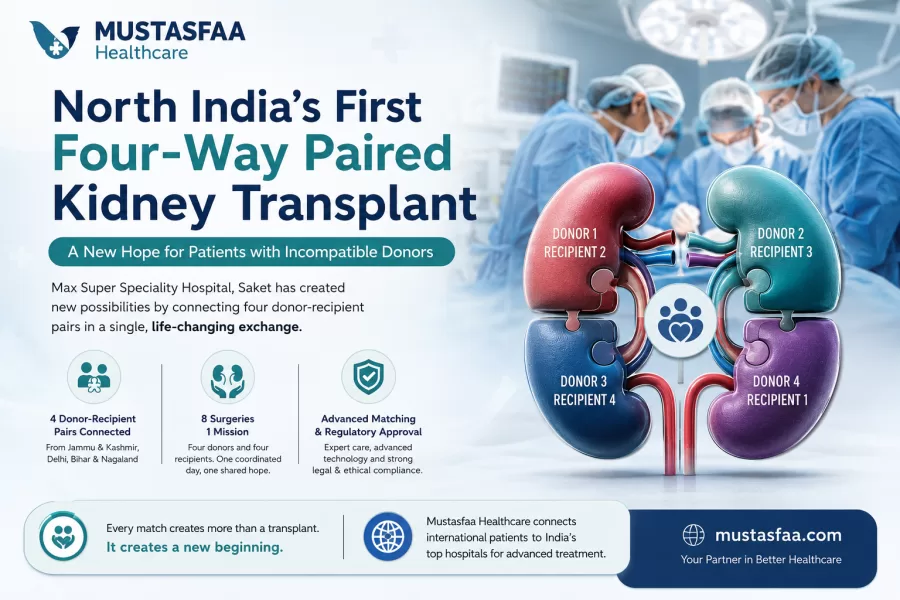
A recent medical milestone in Delhi has shown how modern transplant medicine can overcome this difficult barrier. Max Super Speciality Hospital, Saket has reported North India’s first four-way paired kidney exchange, connecting four donor-recipient pairs from different parts of India.
When a Willing Donor Cannot Donate
Kidney transplantation is often associated with a simple picture: a family member donates a kidney to a loved one. In reality, the process is much more complex. Even when a husband, wife, brother, sister or other relative is willing to donate, the transplant may not be possible if the donor and recipient are incompatible.
Blood-group incompatibility is one possible barrier. Another is immunological incompatibility, where the recipient’s immune system has antibodies that can react against the donor’s kidney.
For families facing this situation, the news can be devastating. They may have a healthy and willing donor standing beside them, yet still be unable to proceed with a direct transplant.
How Paired Kidney Exchange Can Help
A paired kidney exchange offers another possibility. Instead of each donor giving directly to their own family member, incompatible donor-recipient pairs can be connected with other pairs.
In simple terms, Donor A may be incompatible with Patient A but compatible with Patient B. At the same time, Donor B may be compatible with Patient A. The two families can therefore exchange donors, allowing both patients to receive a compatible kidney.
In the four-way exchange performed at Max Super Speciality Hospital, four donor-recipient pairs were connected into one coordinated chain. The donors came from families based in Jammu and Kashmir, Delhi, Bihar and Nagaland.
Eight Surgeries, One Coordinated Plan
The reported procedure involved four kidney donors and four recipients, requiring eight surgeries to be coordinated on the same day. The operations were carried out simultaneously across multiple operating theatres, making timing, matching and coordination extremely important.
The transplant team used detailed blood-group testing, HLA typing, cross-matching and immunological evaluation before establishing the exchange chain. Technology and specialised matching software also supported the identification of suitable donor-recipient combinations.
The procedure was not only a surgical challenge. Because of the complexity of a four-way exchange, the team also had to navigate an extensive regulatory approval process, which ultimately involved proceedings before the Delhi High Court.
Why This Matters for Kidney Transplant Patients
The importance of this achievement goes beyond one hospital or four families. It highlights an important possibility for thousands of patients who have a willing family donor but cannot receive that kidney because of incompatibility.
For such patients, the question may no longer simply be, “Do I have a donor?” It may also be, “Is there a compatible donor-recipient pair within a larger exchange programme?”
Expanding awareness of paired kidney exchange programmes could potentially help more families explore transplantation when direct donation is not possible.
A Human Story Behind the Medical Achievement
Behind every transplant statistic is a family that has spent months or years dealing with dialysis, uncertainty and difficult medical decisions.
For a patient, a transplant is not just another procedure. It can mean fewer hours connected to dialysis, more freedom in everyday life and the possibility of returning to work, family responsibilities and ordinary routines.
That is why innovations such as paired kidney exchange matter. They do not simply change the surgical technique; they can change the options available to families who previously believed that incompatibility meant the end of their transplant journey.
Kidney Transplant Care in India
India has developed advanced kidney transplant programmes supported by experienced nephrologists, transplant surgeons, urologists, immunology teams and specialised transplant coordinators. However, every patient and donor requires individual medical assessment.
International patients considering kidney transplantation in India should not make decisions based only on online information. A transplant centre must evaluate the patient’s medical history, kidney function, blood group, HLA profile, donor suitability and other clinical factors before determining the appropriate treatment pathway.
What International Patients Should Know
For patients travelling to India for kidney transplant treatment, medical care is only one part of the journey. Proper coordination of medical records, consultations, donor evaluation, investigations, travel documentation, accommodation and follow-up care is equally important.
At Mustasfaa Healthcare, our role is to help international patients understand the treatment journey and coordinate their medical travel requirements with appropriate hospitals and healthcare teams in India.
Whether a patient is exploring a conventional living-donor transplant, a paired exchange programme or another treatment option, the first step should always be a detailed evaluation by a qualified transplant team.
A New Possibility for Families Facing Incompatibility
The four-way paired kidney transplant reported at Max Super Speciality Hospital, Saket is an important reminder that medical compatibility does not always have to be limited to one donor and one recipient.
With advanced testing, specialised transplant teams, technology, regulatory coordination and cooperation between families, the potential donor pool can be used more effectively.
For families who have a willing but incompatible donor, paired kidney exchange may offer a new avenue worth discussing with a transplant specialist.
Important: Kidney transplantation is a major medical procedure. Eligibility, donor suitability and treatment options vary from patient to patient and must be determined by a qualified transplant team after complete medical evaluation.
