Our eyes are something most of us take for granted until our vision starts changing. Blurred vision, difficulty reading, frequent headaches, increasing dependence on glasses or trouble seeing at night can sometimes be more than just a normal part of getting older.
Modern ophthalmology has changed the way eye problems are detected and treated. Today, advanced imaging, computer-assisted diagnostics, laser technology and AI-supported systems can provide ophthalmologists with much more detailed information about the eye.
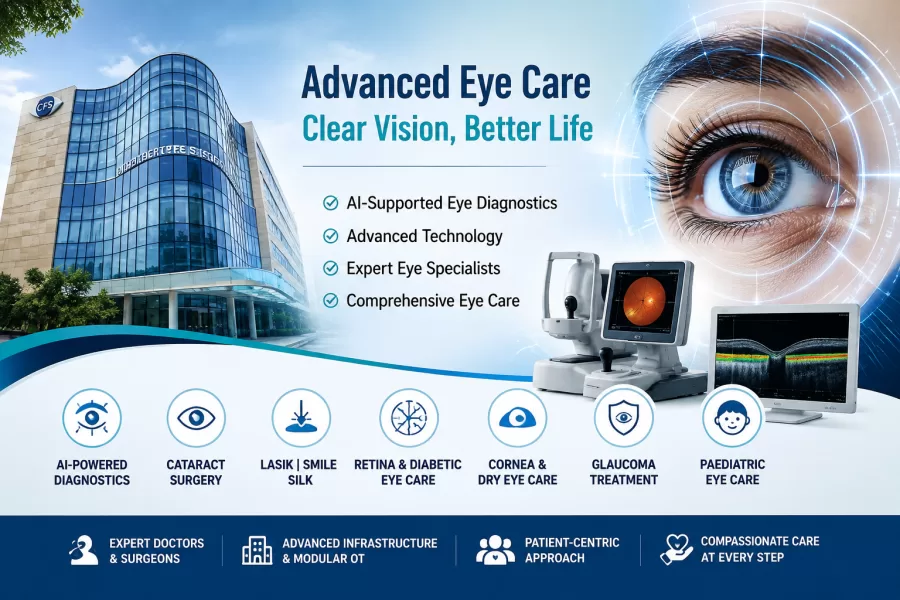
Centre For Sight Eye Institute, Dwarka, New Delhi is built around this modern approach to comprehensive eye care. The institute provides a wide range of services, from routine eye examinations and cataract treatment to advanced refractive surgery, retina, glaucoma, cornea, paediatric ophthalmology, neuro-ophthalmology and other specialised eye-care services.
AI-Supported Technology in Modern Eye Care
Artificial intelligence is becoming an important supporting technology in ophthalmology. Instead of depending only on a conventional eye examination, modern computer-based systems can analyse detailed information obtained from diagnostic tests and help specialists identify important patterns.
Centre For Sight has been using advanced technology in vision correction and has introduced AI-supported technology for laser vision correction. Such systems can assist in analysing detailed characteristics of the patient's eyes and support a more personalised approach to treatment planning.
But there is an important point that patients should understand: AI does not replace the ophthalmologist. It works as a supporting tool. The final diagnosis and treatment decision still depend on the patient's clinical examination, medical history, diagnostic results and the specialist's medical judgement.
Advanced Eye Diagnostics
Good treatment begins with an accurate diagnosis. At Centre For Sight's Dwarka Eye Institute, advanced diagnostic technologies are used to evaluate different parts and functions of the eye.
Investigations such as Optical Coherence Tomography (OCT), OCT Angiography, retinal imaging, visual-field testing, corneal mapping and other specialised examinations can help doctors understand eye conditions in greater detail.
These investigations are particularly useful in conditions such as glaucoma, diabetic retinopathy, retinal disorders, corneal problems and complex vision conditions where detailed information is important for treatment planning and follow-up.
Retina and Diabetic Eye Care
Diabetes can affect the delicate blood vessels of the retina, sometimes without producing noticeable symptoms in the early stages. Regular eye examinations can therefore be important for people living with diabetes.
Centre For Sight provides specialised retina and uvea services, including management of diabetic retinopathy, retinal detachment and other vitreoretinal conditions.
Depending on the patient's condition, treatment may involve laser therapy, intravitreal injections or vitreoretinal surgery. Advanced investigations such as OCT and OCT Angiography can help specialists examine retinal structures and monitor disease progression.
Advanced Cataract Surgery
Cataract is one of the most common causes of vision impairment, particularly with increasing age. Modern cataract surgery has evolved considerably, with advanced imaging, precise measurements, modern intraocular lenses and laser-assisted technologies available for suitable patients.
Centre For Sight offers comprehensive cataract care and uses advanced technologies such as femtosecond laser-assisted cataract surgery and micro-incision cataract surgery.
The choice of procedure and intraocular lens depends on the patient's eye health, lifestyle, visual requirements and clinical evaluation. A detailed assessment is therefore essential before deciding on surgery.
LASIK, SMILE, SILK and Vision Correction
For people who want to reduce their dependence on spectacles or contact lenses, modern refractive surgery offers several options.
- LASIK
- SMILE
- SILK
- Contoura Vision
- SmartSurface
- PRK and Trans PRK
- ICL in suitable cases
Before recommending any procedure, an ophthalmologist needs to evaluate factors such as corneal thickness, corneal shape, refractive error and overall eye health.
This is why advanced diagnostic testing is an important part of modern laser vision correction. The goal is not simply to perform a procedure, but to determine whether the procedure is appropriate for that particular patient.
Glaucoma: Early Detection Can Protect Vision
Glaucoma is often called the “silent thief of sight” because it can gradually damage the optic nerve without producing obvious symptoms in the early stages.
Once glaucoma-related vision loss has occurred, it generally cannot be reversed. However, early detection and appropriate treatment can help slow or prevent further damage.
Centre For Sight provides glaucoma evaluation and treatment using clinical examination, visual-field testing, optic nerve assessment and advanced diagnostic technologies. Depending on the condition, treatment may include medication, laser procedures or surgery.
Cornea, Keratoconus and Dry Eye Care
The cornea is the transparent front surface of the eye and plays a major role in focusing light. Conditions affecting the cornea can significantly influence vision.
Centre For Sight provides specialised care for corneal conditions including keratoconus and other corneal disorders. Diagnostic technologies such as corneal topography and Pentacam can provide detailed information about the shape and condition of the cornea.
Dry eye is another increasingly common problem, particularly among people who spend long hours using computers and smartphones. Symptoms can include burning, irritation, a gritty sensation, watering and fluctuating vision.
Paediatric Ophthalmology and Squint Treatment
Children's eyes require special attention because their visual system continues developing during childhood. Problems such as squint, lazy eye, refractive errors and paediatric cataracts may affect normal visual development if they are not identified in time.
Centre For Sight provides paediatric ophthalmology and squint services, including specialised examinations, amblyopia management, corrective glasses, vision therapy and surgical treatment when required.
Neuro-Ophthalmology for Complex Vision Problems
Not every vision problem originates within the eye. The optic nerve connects the eye with the brain, and neurological disorders can also affect vision.
Neuro-ophthalmology deals with complex conditions involving the eye, optic nerve and brain. Centre For Sight's Dwarka facility provides specialised investigations including OCT, visual-field testing, fundus photography, electrophysiological tests and evaluation of eye movements and ocular alignment.
For complex cases, neuro-ophthalmologists may also work alongside neurologists, neurosurgeons and radiologists.
Oculoplasty and Ocular Oncology
Comprehensive eye care goes beyond improving eyesight. Centre For Sight also provides specialised services in oculoplasty and ocular oncology.
Oculoplasty can address conditions affecting the eyelids, tear ducts, orbit and surrounding structures. The institute also provides evaluation and treatment for certain ocular tumours and complex conditions affecting the eye and its surrounding tissues.
Modern Infrastructure at Centre For Sight Dwarka
The Centre For Sight Eye Institute in Dwarka is spread across approximately 90,000 square feet and has six floors, 17 examination chambers, more than 20 consultation chambers and nine technologically advanced modular operation theatres.
The institute also includes an eye casualty and trauma service and an eye bank. Its comprehensive infrastructure allows patients to access multiple specialised eye-care services within the same institute.
Technology and Experienced Eye Specialists: Why Both Matter
It is easy to focus on words such as AI, laser, advanced imaging and computer-assisted diagnosis. But technology by itself does not treat a patient.
A machine produces information. AI can assist with analysis. Advanced imaging can reveal details that may not be visible during a routine examination. The ophthalmologist still has to put all of this information together and understand what it means for the individual patient.
That combination of advanced technology, accurate diagnostics and specialist medical expertise is what makes modern eye care more effective and personalised.
Why Centre For Sight Dwarka Can Be Considered for Comprehensive Eye Care
For patients in Delhi and NCR, Centre For Sight Eye Institute, Dwarka offers a broad range of ophthalmic services in one specialised facility.
From cataract surgery and laser vision correction to retina, glaucoma, cornea, paediatric ophthalmology, neuro-ophthalmology, oculoplasty and ocular oncology, the institute covers many different areas of eye care.
For international patients travelling to India for treatment, having diagnostic facilities and multiple eye-care specialties within one institute can also make the evaluation and treatment journey more convenient and organised.
Final Thoughts
Vision problems should not always be ignored simply because they appear minor. A gradual change in eyesight can sometimes be an early indication of an underlying condition.
The good news is that eye care has become far more advanced. AI-supported systems, high-resolution imaging, laser technology, personalised treatment planning and specialised ophthalmology are changing the way eye diseases are diagnosed and treated.
Centre For Sight Eye Institute, Dwarka combines these technological developments with comprehensive ophthalmic services and specialised clinical expertise. For patients looking for advanced eye diagnostics and treatment in Delhi, it offers a technology-focused approach to modern eye care.
Note: The suitability of any diagnostic test or treatment depends on the individual patient's clinical condition. Patients should consult a qualified ophthalmologist for personalised medical advice.
